
Transmission testers (or manual controllers) are quickly becoming the most often used tester within shops. The Schaffer Shifter( is a universal controller for computer shifted transmissions.
It operates most units from the popular manufacturers and does not require updating, and is designed to operate without any prior computer knowledge or training. The tester provides operation of the various solenoids and internal switches, completely separate from the vehicle computer and is used for determining the source of a problem. It is also useful for bench testing the transmission solenoids. It has a pulse generator with duty control for units with electronic pressure control solenoids. The instructions indicate the approximate pressure to expect in each setting in order to test the unit better when not using a gauge.
LEDs indicate which gear the transmission should be in and will fail to light when a short is present. Adapters included with the Shifter are-early 4EAT & Mazda connector (part of harness D), early 4L80E (bolt on style harness A), 1991 to '93 4T60E (part of harness C), Ford AODE (harness B), 1991 and '92 AXODE (part of harness C), Ford E4OD (part of harness C), Chrysler A604 (harness E), and harness F (with probes) for most Asian imports. The probes will hookup to most imports that have wire leads extending from the unit. Schaffer offers a 1995 adapter update package with 12 adapters and a separate case to extend coverage another three years.
The adapters in the 1995 adapter update package are the 42LE, 4L60E, 4T40E and late 4T80E, early 2-connector 4T80E, A4LD (2 and 3 wire), F4EAT (black 6-way connector), late 4EAT (black 10-way), late 4L80E, 1994 & '95 4T60E, 1993 to '96 AXODE, late Ford E4OD, and early N4AEL. Numerous optional adapters are available. These include the: 4L30E (180C overdrive), 4R44E/55E (A4LDE), AXOD (L/U only), Ford CD4E, Cadillac F-7, KM-175, KM-175-5, GM ECM controlled L/U, late Mazda N4AEL, Renault 3-speed, and Toyota FWD (A140E & A540E) with spades for RWD. Upcoming additions include an audio tach, Asian pressure control module, and Saturn adapter and module.
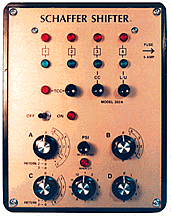
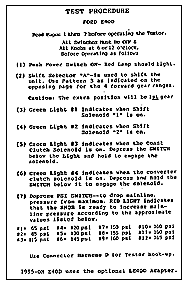

The following is a test procedure for the E4OD, using the Schaffer Shifter (figure 1). Instructions are always on the two facing pages and the adapter to use is always on the bottom of the right page. The adapters are 18" to 24" long and attach to the transmission. The other end plugs into the Shifter when working close to the unit, or the 8' harness can be used when working in the vehicle. The 12-pin output is unmistakable as well as the two-pin for connecting the power cord. The other end of the power cord has a male cigarette lighter receptacle (a battery adapter is also included). The only learning curve to remember is that every test begins with all of the knobs and switches off and all sequencing patterns are always on (thus avoiding any user set-up). Therefore, use only the knob and pattern indicated in the test procedure being used. For instance, in this E4OD procedure, knob A is used to shift the unit according to the sequencing of pattern 3 (the outside set of numbers for 1st, 2nd, 3rd, and 4th gears). The C/C button is shown to be used for the coast clutch and L/U button is for TCC operation. If the transmission functioned as ordered and verified computer system malfunction, then the test is over. The solenoid sequence chart above the picture, various lights and the written text were not needed, but they are very important when the transmission fails.
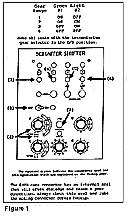
Each circuit within the Shifter except ground (Pin 4) has its own indicator light (figure 2). Page seven of the manual shows the pin location of each circuit and which circuit each light is connected to. The newest manuals also indicate the wire color of that circuit, which (except for the F universal adapter and Toyota FWD) will be on all wiring of that circuit even at the transmission connector pin. The LEDs will fail to light if there is excessive current draw within its circuit. Therefore, if all lights function property during operation, there is no need for amperage checks. The LEDs can not check for an open circuit, but you know it is closed if the solenoid functioned. If it didn't, then you have the wire colors to show you the circuit to check in the transmission.
The pressure control of the standard Schaffer Shifter is unique in that it has 12 preset positions on the control knob. Using the same E4OD example: It is slip-shifting under one-half to full throttle. The written instructions on the right page list the approximate pressure in each position of the 12 position knob. If you decide that you want about 115 psi for a half throttle upshift, then you turn the knob to position three. You might also drive the vehicle in lower and higher positions to check for proper solenoid response. If you feel that it responds well to change, then you know that you have a computer related problem. If you feel no response, then you know you have a transmission problem. Either way, the Schaffer Shifter has provided a pressure diagnosis without hooking up a gauge.
One common concern with testers is whether they might overpower the solenoids and actually operate the transmission better than the computer. This is a real concern, since that could easily lead to misdiagnosis of a marginal unit. All solenoid circuits of the Schaffer Shifter are operated through current limiters. This Involved a considerable amount of testing to determine how much current to allow, but the end result has been worth it (because electronic calculations never seem to apply consistently to an automotive environment). The end result is that the Schaffer Shifter will not power as well as the vehicle's computer and most intermittent solenoid concerns show up better and more consistently. This does create a change that a user needs to be aware of. We are only letting a minimum amount of amperage through which means that when bench testing, you can no longer judge a solenoid by its snap. You must actually blow through or test the valve action, with flow. The valve in the solenoid would still work, but that overpowering extra current isn't there and should not be for a true test.
One last point concerning diagnosis is monitoring. It has always been my opinion that once manual control is available, monitoring is hardly, If ever, necessary. The Schaffer Shifter can monitor if needed. The harness F that is included in the standard package can be used to monitor up to three circuits. The Bed of Needles clips can be clamped on to the desired wires. The power cord must be connected and the main shifter switch must be turned to on. Red lights one and two connect to the white and black probes and the red TCC light connects to the yellow probe.