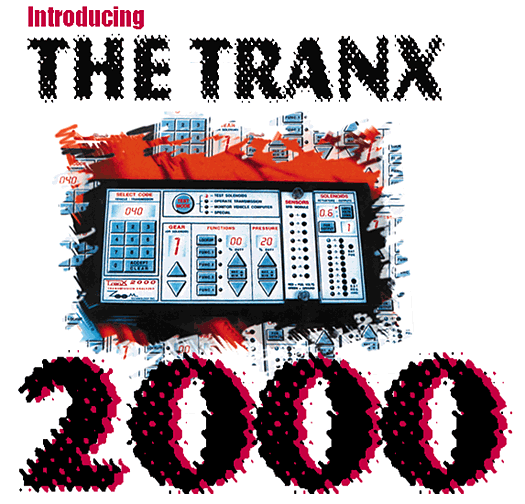
Zoom Technology has been manufacturing transmission testing equipment since 1984. Our first product was an inexpensive lockup tester, the GM-1. Currently, Zoom manufactures the TranX 101, a high-tech, easy-to-use computerized shifter, and several other types of transmission testers. The following article provides an overview of testing methods, and introduces our newest entry into the transmission rebuilding industry, the TranX 2000.
When diagnosing a vehicle, you have three potential areas for problems: the transmission itself-the vehicle's ECU- and peripheral components, including harnessing. It's not unusual to find problems in more than one area, because transmission problems tend to ripple.
To test and troubleshoot a vehicle, you need the ability to isolate the transmission from the ECU. At times, you also need to look at everything together. Figure one illustrates the 3 possible approaches to testing.
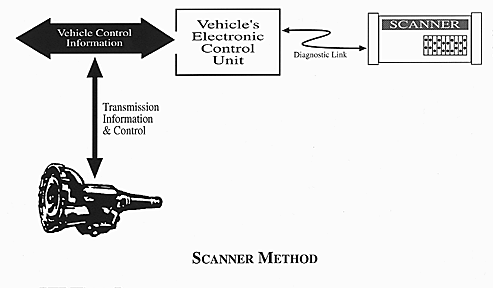
Figure 1a
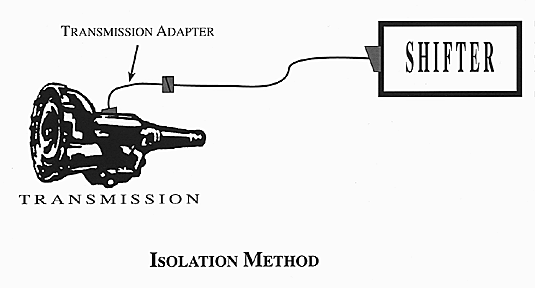
Figure 1b
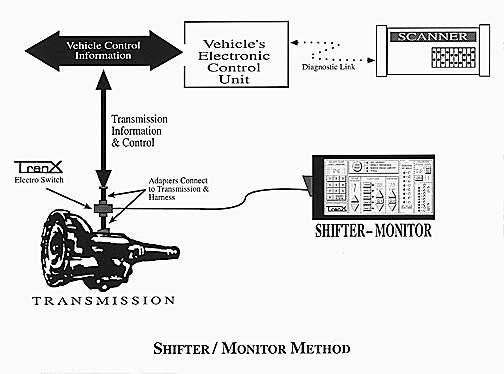
Figure 1c
Scanner Method
The ability to retrieve codes is critical in repairing today's sophisticated
vehicles. Most shops have already invested in scanners and are using this method
regularly to diagnose problems. While there are some people out there who will
tell you a scanner is all you need, most will agree that there are times when
a scanner is simply not enough.
Without a doubt, a scanner is a very useful tool-but you can't bench test with one, and what do you do when it's the ECU that's broken and you can't use the scanner?
Isolation Method (Shifter)
The Isolation Testing Method uses a shifter to replace the ECU and
drive the transmission. You can see from figure one that the shifter approach
separates the transmission from everything else. The vehicle becomes a Dyno
when you use this method to diagnose problems-because you've eliminated the
vehicle's computer and harness from the picture. This approach is effective
when you are looking for electrical, hydraulic or mechanical problems in the
transmission. In fact if you look at any modern dyno or valve body test system,
they include a shifter.
What are the pitfalls of Isolation Testing? You have rebuilt the transmission and feel you are home free. The biggest problem is that finally at some point you have to reconnect the transmission to the system. What if the system still doesn't work? You know the transmission is okay, right? Now what's next? Of course you can fall back to your scanner, but it may be a bad connection, so you get out the multimeter and root around. You could send the customer up the street to have the system fixed-they'll really like that! So what do you do? Well, how many hours do you have?
The Shifter/Monitor approach connects to the transmission case and engine harness. You are focused at the business end of the system and can quickly analyze the transmission both as a component and as part of the overall system. By adding a scanner, you can check the ECU and overall system health. Some of the newer vehicles can actually be shifted using the scanner and, with the monitor in place, you can observe the electrical signaling between the ECU and transmission.
Introducing the TranX 2000 Transmission Analyzer
The TranX 2000 (a shifter/monitor) is the culmination of several
years' experience serving the transmission rebuilding industry. Our goal for
this unit was to provide a simple, easy-to-use tester that would be adaptable
to every electronic transmission. We wanted a tester that could either manually
shift the transmission, or monitor the vehicle's computer as it shifts the transmission.
We also wanted a tester that could be used as a companion tool with a scanner.
Most importantly, we wanted a product that would help you find the problems
fast!
Here's how the TranX 2000 works:
The TranX 2000 operator controls are divided into five functional sections: Transmission code selection, test mode, transmission control and monitoring, sensor monitoring and solenoid monitor/multimeter (Figure 2). This simple and orderly placement of controls makes learning to use the TranX 2000 easy. The same testing app-roach is used for each transmission type. This really makes the TranX easy to learn and easy to use. It also makes it universal!
Transmission Code Selection (Figure 2)
We use a simple three digit code to identify the vehicle/transmission you're
going to test -the codes are all listed in our instruction manual. Identify
the transmission, look up the code, and punch it in-it's that simple!
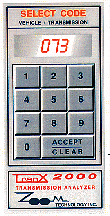
Figure 2a-Select Code
Test Mode (figure 2)
The TranX can perform four types of tests. To select the test you want,
push the test mode button: An LED lights as you select each test.
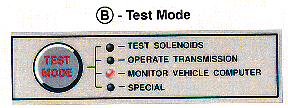
Figure 2b-Test Mode
Here is a summary of what each test will accomplish:
Transmission Control Seven Monitoring (figure 2)
This section of the TranX 2000 contains the switches and displays that control
the transmission. This section has three parts.
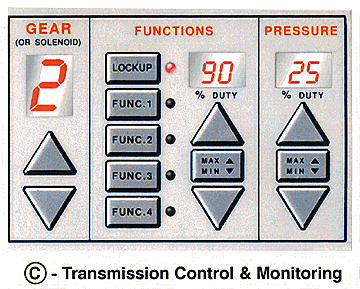
Figure 2c-Transmission Control & Monitoring
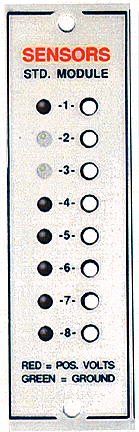
Figure 2d-Sensor Monitoring
Need more accuracy? Each sensor has a test point which you can plug in a scope, multimeter or frequency meter, neatly and conveniently. And we have an eye on the future, too - the sensor module can be changed, so that, as your needs evolve, we can provide other modules.
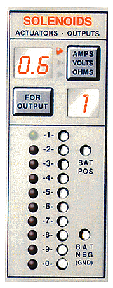
Figure 2e-Solenoid Monitor/Multimeter
The Lower display is a one-character LED and will display A for all outputs (for total current, total average voltage, or total ohms). Zero through nine displays for individual solenoid outputs.
The digital multimeter is active in all modes. If, for instance, you think you have a bad connection in the shift solenoid two circuit, all you have to do is measure the current or voltage for output two. It's that easy!
Solenoid Indicators
The lower half of this section provides both test points and bicolor
LEDs for monitoring each of the 10 TranX solenoid driver circuits. The LEDs
indicate the state of the solenoid circuit and are red for positive voltage,
green for ground, orange for pulsing and off for floating. There are test points
for each solenoid, as well as battery positive and battery negative.
Hook Up
When we designed the TranX 2000 we had a couple of key objectives:
After studying the problem, we decided to separate the controls and displays from the switching and driving circuits. This enabled us to run short, heavier cable between the transmission and computer harness and thinner, more flexible cable to the tester.
As you can see from the photo, we actually use two separate cables to shift and monitor. If the unit is used as a shifter, you can leave off the monitor cable. This makes things neater for bench testing. Also, we have two ways to apply power to the TranX 2000: We can plug the lighter cable into the TranX 2000 in the car or into the TranX 2000 switch box under the hood. This feature makes using your scanner with the TranX 2000 easier.
At the time of this article, we have 35 different adapter sets available and expect to complete several others by the end of the year. Adapters are available for most domestic, Asian and European vehicles. All adapters are clearly marked with part numbers and application.