Chapter 3
Diagnostic Trouble Codes
|
|
|
Retrieving the Codes
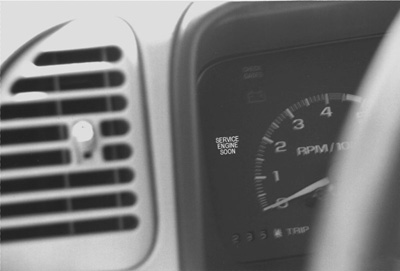
General Motors vehicles provide diagnostic trouble codes by flashing the malfunction indicator lamp, or MIL. On earlier vehicles, this light may be the "Check Engine" light or the "Service Engine Soon" light; regardless of the name on the light, they all have the same purpose: To indicate problems in the computer system, and to flash out diagnostic trouble codes.
The first step in retrieving the diagnostic trouble codes is to find the diagnostic link connector, or DLC. This is the connector that provides access to the computer system, using a scan tool or diagnostic computer. You may know it as an ALDL or ALCL.
In addition to providing an outlet for plugging in a scan tool, you can also use the diagnostic link connector to force the malfunction indicator lamp to flash out diagnostic trouble codes; here’s how:
• Turn the key off.
• Find the diagnostic link connector; it’s usually under the dash, right near the driver’s seat, but on some vehicles it can be in the ash tray compartment, glove box… even in the center console. If you can’t find the link, refer to your shop manual.
• Run a jumper between terminals A and B. This grounds the test terminal, placing the system in diagnostic mode.
• Turn the key on, engine off.
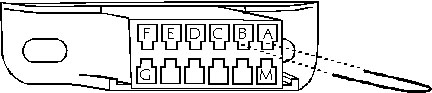
To read any codes in memory, run a jumper between terminals A and B
on the diagnostic link connector, and turn the key on.
The malfunction indicator light should begin flashing; first one flash, a short pause, then two more flashes, just like this:


Code 12 indicates no problems, as long as the engine isn't running.
Then a slightly longer pause, and the same pattern of flashes, two more times. This indicates diagnostic trouble code 12. Code 12 indicates that there’s no reference pulse from the ignition system—just what you’d expect with the key on, engine off.
After code 12 flashes three times in a row, any other codes in memory follow; watch these flashes carefully—missing a single flash will have you chasing a ghost! Record any codes you see, for translation and diagnosis later. Here’s what code 31 looks like:

Here's how code 31 would look:
If there are no codes in memory, the system continues flashing code 12.
Record any codes in memory, clear the codes and road test the vehicle.
Then recheck the codes, and compare the original codes with those you retrieved after the road test.
Once you’ve recorded any codes that were in memory, clear the codes and road test the car again. If the transmission shifts okay, and no codes return, there may not be anything wrong with the transmission or computer system. More than one vehicle has been repaired simply by clearing the codes.
Another possibility is the problem may be intermittent, or only occurs during a specific set of circumstances. Return the car to the customer, and explain the situation. Keep the codes you recorded originally on record, in case the problem returns.
There are three possible situations you can run into when checking the codes this way:
1. The codes after your road test are the same as those from beforehand — these codes indicate a hard code; that is, a problem that’s there now. You should be able to find these problems fairly easily, by following the diagnostic procedures in your shop manual.
2. The codes after your road test are new; they weren’t there before — these codes are also probably hard codes. The codes that were there beforehand may have been preventing the conditions that enabled these new codes to set. Once again, refer to your shop manual for the diagnostic procedures for these codes.
3. The codes that were there originally didn’t return — these are the problem codes. They may be left over from a previous failure, or they may indicate an intermittent failure. They may even indicate a problem that hasn’t reached the conditions necessary to reset. In any case, they may be very hard to find.
Try comparing the codes to the complaint; very often the two will correspond, such as a late shift and a vehicle speed sensor code. This will at least point you in the right direction.
If you can’t find a problem, and the transmission seems to shift okay, keep a record of your test results, and return the car to the customer. If the problem returns, you can compare the new condition with the original tests, to find the problem.
Clearing the Codes
 Never disconnect the battery cable to clear the codes. Disconnecting the battery will clear all memories from the vehicle: radio presets, anti-theft codes, seat memories — all these and more will disappear if you disconnect the battery. And that’ll leave you with a whole series of headaches… and an unhappy customer.
Most cars and trucks have a battery-powered fuse that supplies constant voltage to the computer, even when the key’s off. This fuse provides the power to keep the computer memory alive. Look for this fuse in the fuse block, marked "ECM" or something of that nature. If you’re not sure which fuse it is, check your shop manual.
Remove the fuse from the fuse block, and wait for 10 seconds. This clears the computer memory, and erases any codes that were there.
GM’s Diagnostic Trouble Codes
This list provides all of the diagnostic trouble codes for GM vehicles, up to the introduction of OBD-II. Many of these codes vary their definition, depending on vehicle year or model. If you aren’t sure what condition one of these codes indicates, always check your shop manual for the specific year, make and model vehicle you’re working on.
|
Code |
Definition |
|
12 |
No Distributor or RPM Reference Pulse |
|
13 |
O2 Sensor Circuit |
|
14 |
Coolant Sensor Circuit — High Temperature |
|
15 |
Coolant Sensor Circuit — Low Temperature |
|
16 |
System Voltage High |
|
17 |
Spark Reference Circuit |
|
18 |
Open Crank Signal Circuit |
|
19 |
Shorted Fuel Pump Circuit |
|
20 |
Open Fuel Pump Circuit |
|
21 |
TPS Voltage High |
|
22 |
TPS Voltage Low |
|
23 |
EST Bypass Circuit (DFI) |
|
24 |
VSS or Park/Neutral Switch |
|
25 |
Air Switch Solenoid Circuit (S10/15 with Carb) |
|
26 |
QDM Error |
|
27 |
2nd Gear Switch Circuit Problem or Open 4th Gear Switch |
|
28 |
3rd Gear Switch Circuit Problem or Open 4th Gear Switch |
|
29 |
4th Gear Switch Circuit Problem |
|
30 |
ISC Circuit Error (DFI) |
|
31 |
Shorted MAP Sensor Circuit (DFI) |
|
32 |
Baro Sensor Voltage Signal Low |
|
33 |
MAP Sensor Signal Voltage High |
|
34 |
MAP Sensor Signal Voltage Low or Vacuum Sensor Circuit Problem |
|
35 |
ISC Error (Carb) |
|
36 |
Closed Throttle Vacuum Low (2.3 PFI) |
|
37 |
Shorted MAT Sensor (DFI) |
|
38 |
Open MAT Sensor (DFI) |
|
39 |
TCC or VCC Engagement Problem |
|
40 |
Open Power Steering Pressure Circuit (DFI) |
|
41 |
No Distributor Reference Signal (Carb) |
|
42 |
EST Error |
|
43 |
EST Retard Signal Low |
|
44 |
O2 Sensor Signal Lean |
|
45 |
O2 Sensor Signal Rich |
|
46 |
Power Steering Pressure Switch |
|
47 |
ECM/PCM/BCM Data Problem |
|
48 |
Misfire Diagnosis |
|
49 |
Air Management System Fault |
|
50 |
Second Gear Pressure Circuit (Allanté) |
|
51 |
PROM/Mem-Cal Error |
|
52 |
Mem-Cal CalPal ECM Error |
|
53 |
System Voltage High |
|
54 |
M/C Solenoid Circuit Voltage High (Carb) |
|
55 |
ECM Error |
|
56 |
Open 4th Gear Switch Circuit or Shorted 3-4 Shift Solenoid (Allanté) |
|
57 |
PCM/BCM Data Circuit Problem |
|
58 |
Antitheft System Problem |
|
59 |
Transmission Temperature Circuit Problem (DFI) |
|
60 |
Cruise Control — Transmission Not in Drive |
|
61 |
Cruise Control — Vent Solenoid Circuit Problem |
|
62 |
Cruise Control — Vacuum Solenoid Circuit Problem |
|
63 |
Cruise Control — Car Speed and Set Speed Difference Too High |
|
64 |
Cruise Control — Car Acceleration Too High |
|
65 |
Cruise Control — Servo Position Sensor Failure |
|
66 |
Cruise Control — Engine RPM Too High |
|
67 |
Cruise Control — Switch Shorted During Enable |
|
68 |
Cruise Control — System Error |
|
69 |
A/C Pressure Switch Circuit |
|
70 |
Intermittent TPS Signal (DFI) |
|
71 |
Intermittent MAP Sensor Signal (DFI) |
|
72 |
Vehicle Speed Control Circuit Loss |
|
73 |
Force Motor Current Error (4L60E, 4L80E) |
|
74 |
Intermittent MAT Sensor Signal (DFI) |
|
75 |
Intermittent VSS Signal (DFI) |
|
79 |
Transmission Fluid Over Temperature (4L60E) |
|
80 |
Fuel System Rich (DFI) |
|
81 |
Shift Solenoid B Circuit Error (4L60E, 4L80E) |
|
82 |
Shift Solenoid A Circuit Error (4L60E, 4L80E) |
|
83 |
TCC Solenoid Circuit Error (4L80E) |
|
85 |
Throttle Angle Too High (DFT) |
|
86 |
Low Ratio Error (Solenoid B Closed) (4L80E) |
|
87 |
High Ratio Error (Solenoid B Open) (4L80E) |
|
90 |
VCC Brake Switch Signal Problem (DFI) |
|
91 |
PRNDL Switch Problem (DFI) |
|
92 |
Heated Windshield Request Problem (DFI) |
|
96 |
Torque Converter Overstress (DFI) |
|
97 |
P/N to D/R at High Throttle Angle (DFI) |
|
98 |
High RPM From P/N to D/R in ISC Range (DFI) |
|
99 |
Cruise Control — Servo Apply Problem (DFI) |
PAGE 26-33